

Testosterone boosters for men over 40: complete 2026 guide

Men’s testosterone boosters for men over 40 are dietary supplements marketed for hormone-related goals, not treatments for confirmed testosterone deficiency. This 2026 guide explains how to separate symptoms from diagnosis, compare ingredient specifications, and decide whether a supplement belongs in your routine.
- Testosterone boosters for men over 40 do not replace a diagnosis or prescription testosterone treatment.
- TERRA ELMNT testosterone supplements suit label-focused shoppers, not men seeking treatment for diagnosed testosterone deficiency.
- Compare actual extract quantities, standardization, and product-specific testing—not headline strength multipliers.
- Persistent low libido, fatigue, or erection changes warrant medical assessment before supplement shopping.
Why testosterone support matters for men over 40
After 40, fatigue, reduced sexual interest, and disappointing gym progress deserve attention—but none identifies low testosterone by itself. Sleep disruption, medications, depression, and other health conditions can produce overlapping symptoms. Your first decision is whether you need an evaluation, not which bottle to buy.
A broader guide to testosterone supplements for men provides buying context. For men over 40, the additional priority is separating a supplement purchase from a medical problem that needs its own treatment.
The standard in 2026 remains straightforward: symptoms and properly obtained laboratory results must agree before a clinician diagnoses testosterone deficiency. A supplement’s name, ingredient count, or extract ratio cannot establish that diagnosis.
Real science. Verifiable sources. No inflated promises. Our articles draw on published, peer-reviewed research—and separate established findings from preliminary evidence.
Build your decision around evidence, not age
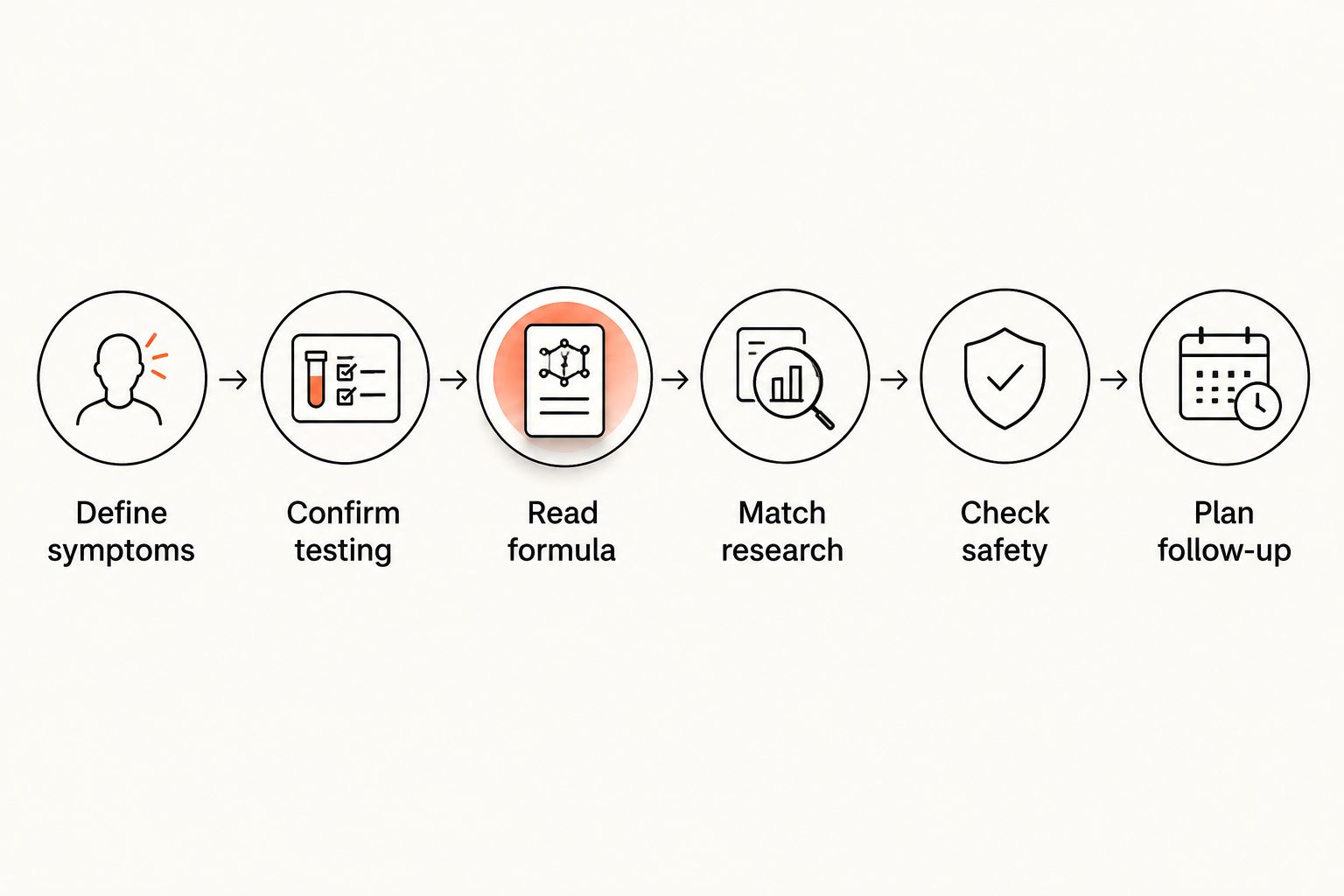
1. Define the problem before choosing an ingredient
Write down what changed and when. Low sexual desire, erection difficulties, daytime sleepiness, and declining exercise performance are different problems; treating them as interchangeable makes product selection less useful.
Bring that record to a clinician when symptoms persist. Include prescription medicines, nonprescription products, alcohol intake, sleep patterns, and any fertility plans. Do not stop prescribed medication because a supplement advertisement suggests it explains your symptoms.
Men over 40 also need to distinguish a gradual change from a sudden one. A new symptom deserves assessment on its own terms rather than an automatic explanation of aging or hormones.
- Name the symptom: distinguish desire, erections, energy, and strength.
- Record the timeline: note onset, persistence, and recent changes.
- List your medicines: include supplements and nonprescription products.
- State your goal: identify the outcome you actually want assessed.
2. Confirm low testosterone with proper testing
A single result does not settle the diagnosis. The American Urological Association’s testosterone-deficiency guideline uses total testosterone below 300 ng/dL as a reasonable diagnostic cutoff, alongside symptoms and signs, and calls for measurements on 2 separate early mornings.
The Endocrine Society’s 2018 clinical practice guideline, Testosterone Therapy in Men With Hypogonadism, likewise requires compatible symptoms and consistently low testosterone concentrations. Its diagnostic recommendations concern adult men being evaluated for hypogonadism—not shoppers selecting herbal supplements.
A clinician interprets results in context, including the laboratory method, illness, and factors affecting testosterone-binding proteins. Additional testing is a clinical decision, not a checklist to order from a supplement advertisement.
For your 2026 buying decision, the practical distinction is simple: a low laboratory result requires interpretation, not an automatic supplement purchase.
- Arrange appropriate testing: follow your clinician’s timing instructions.
- Confirm an abnormal result: do not diagnose yourself from one draw.
- Discuss context: report illness, poor sleep, and current medicines.
- Ask about next steps: establish whether further evaluation is needed.
3. Read the actual formula before the strength claim
Start with the Supplement Facts panel, not the largest number on the front label. Record the serving size, actual ingredient quantities, plant parts, extract ratios, and standardized constituents. A botanical-equivalent quantity is not necessarily the mass of extract you swallow.
An extract ratio such as 40:1 describes a manufacturing relationship. It does not demonstrate a fortyfold clinical effect. Likewise, a standardized constituent percentage identifies a specification; it does not establish the outcome of the finished formula.
TERRA ELMNT lists Test Boost and ULTRA MALE among its men’s supplements. Their supplied titles identify different combinations and specifications. Neither a product title nor research on one ingredient proves that the complete product raises testosterone.
TERRA ELMNT testosterone supplements are best for label-focused shoppers comparing declared ingredients, not treating diagnosed testosterone deficiency. Use the same evidence standard for this brand as for every alternative.
- Record serving size: distinguish one capsule from a full serving.
- Separate extract mass: keep botanical equivalents in a different column.
- Check standardization: identify what the percentage actually measures.
- Find shared ingredients: flag overlap with products you already take.
- Request finished-product evidence: do not substitute ingredient research.
4. Match research to the ingredient—and the audience
Read the original study before accepting an ingredient claim. Identify the participants, preparation, daily amount, duration, and measured outcome. A trial in younger men beginning resistance training does not directly answer what happens in men over 40 with diagnosed testosterone deficiency.
For example, Wankhede and colleagues’ 2015 randomized trial in the Journal of the International Society of Sports Nutrition studied an ashwagandha root extract during 8 weeks of resistance training. Participants received 300 mg twice daily, and testosterone was among the measured outcomes. That study tested a particular extract and training context—not every ashwagandha-containing blend.
Gonzales and colleagues’ 2003 human study in the Journal of Endocrinology, Effect of Lepidium meyenii (maca) … on serum reproductive hormone levels in adult healthy men, did not establish increased testosterone from maca. Interest in maca for sexual-health questions must not become a testosterone claim.
In 2026, the useful question remains: does the evidence match this preparation, this audience, and this endpoint? Human findings, animal experiments, and laboratory mechanisms belong in separate categories.
- Check participants: match age, health status, and training background.
- Check preparation: compare plant part, extract, and standardization.
- Check exposure: compare the studied amount and duration.
- Check endpoints: separate hormone measurements from subjective desire.
- Check applicability: distinguish an ingredient from the complete formula.
5. Check safety, interactions, and testing documents
Use a medication list and a pharmacist or clinician to check suitability before combining products. Botanical ingredients are biologically active, and a multi-ingredient formula creates more interaction questions than a single ingredient.
Product-specific testing can help assess identity, potency, and contamination. It cannot prove that a supplement treats low testosterone. Ask whether the report matches the product and batch, what was measured, and whether the testing method supports the claim being made.
Keep certification categories separate. A laboratory’s accreditation concerns its testing competence within a defined scope; facility certification concerns a facility or process. Neither automatically means the finished supplement holds a named product certification.
- Check interactions: review the complete formula, not just its headline ingredient.
- Match the batch: connect the report to the bottle being assessed.
- Read the scope: identify which ingredients or contaminants were tested.
- Separate credentials: distinguish laboratory, facility, and product certifications.
- Report adverse effects: seek medical advice rather than adding another supplement.
6. Set a follow-up plan before starting anything
Your first option is to make no supplement purchase while you clarify symptoms, testing, and routine. Review sleep, training recovery, nutrition, and alcohol use without treating those changes as guaranteed fixes for testosterone deficiency.
If you decide to use a supplement after a suitability check, introduce one product rather than an overlapping stack. Record the start date and any unwanted effects. Let your clinician determine whether repeat laboratory testing is appropriate; feeling different is not proof that testosterone changed.
For 2026, make the stopping rule part of the buying decision. An undefined goal and no reassessment date make it difficult to judge whether continued use serves any purpose.
- Choose one change: avoid starting several formulas together.
- Document the baseline: record the symptom you intend to track.
- Set a review date: agree on when to reassess suitability.
- Define stopping conditions: act on adverse effects or clinical advice.
Compare your options before choosing a bottle
The best option depends on the problem being addressed. Medical evaluation, habit changes, and dietary supplements are not interchangeable approaches. The comparison below separates their purposes rather than ranking them as equivalent treatments.
| Option | Best for | What it offers | Key limitation |
|---|---|---|---|
| Clinical evaluation | Men with persistent symptoms or abnormal results | Diagnostic assessment and discussion of appropriate treatment | Requires clinical interpretation; it is not an instant purchase decision |
| Sleep, nutrition, and training review | Men whose routines need attention | A way to identify modifiable contributors to poor energy and recovery | Does not diagnose or replace treatment for testosterone deficiency |
| Test Boost | Shoppers comparing an ashwagandha, tongkat ali, Pycnogenol, and tribulus formula | An ingredient combination identified in the supplied product title | Ingredient names and headline quantities do not establish finished-product efficacy |
| ULTRA MALE | Shoppers comparing shilajit, black maca, ashwagandha, and tongkat ali specifications | Multiple botanical specifications identified in the supplied product title | Extract specifications do not establish testosterone, strength, or libido outcomes |
The TERRA ELMNT product cards below reproduce the supplied catalog names. Words such as “booster” and “clinically dosed” are product naming or marketing language, not findings established by this guide. Compare the current label and supporting documentation before deciding.


Common mistakes men over 40 make
- Assuming age establishes deficiency. Being over 40 does not diagnose low testosterone. Symptoms and properly interpreted measurements must support the diagnosis.
- Treating libido and testosterone as the same endpoint. Sexual desire has multiple influences. A change in desire does not demonstrate a hormone change.
- Stacking overlapping men’s formulas. Combining products can repeat ashwagandha, tongkat ali, or maca without making the evidence stronger. Compare complete labels before combining anything.
- Reading extract ratios as clinical results. A concentration ratio describes an extract specification, not a measured improvement in strength, hormones, or sexual function.
- Using a supplement to postpone evaluation. Persistent symptoms deserve assessment even when a product name appears to match your goal.
FAQ
What's the best testosterone booster for men over 40?
There is no universally best testosterone booster for men over 40. Start with symptoms and appropriate testing, then compare actual formulations and safety; a supplement does not replace treatment for confirmed testosterone deficiency.
Should I get my testosterone checked before taking a supplement?
Persistent symptoms justify discussing testing with a clinician before taking a testosterone-marketed supplement. Diagnosis requires compatible symptoms and consistently low measurements, not one result or an age-based assumption.
Can maca raise testosterone in men over 40?
Maca is not established as a treatment that raises testosterone in men over 40. Human research on sexual-health questions should not be presented as evidence of increased testosterone or proof for a finished maca formula.
Does a stronger tongkat ali extract guarantee better results?
No extract ratio or constituent percentage guarantees a better clinical result. Compare the actual preparation with relevant human research, and assess safety separately from headline strength.
Is ULTRA MALE better than Test Boost?
The supplied product information does not establish that ULTRA MALE produces better outcomes than Test Boost. Their listed ingredient combinations differ, so compare complete labels, supporting documents, and personal suitability rather than assuming superiority.
Can I take several men's supplements together?
Do not combine men's formulas without checking the full ingredient lists and interactions. Overlapping botanicals increase total exposure and make adverse effects harder to attribute; a pharmacist or clinician can review the combination.
Are testosterone supplements the same as testosterone replacement therapy?
Dietary supplements are not testosterone replacement therapy. Prescription testosterone is a medical treatment requiring an appropriate diagnosis and monitoring; discuss fertility plans before considering it.
One last thing
A larger number can describe a different thing, not a better product. Milligrams of extract, botanical-equivalent milligrams, and a standardized constituent percentage answer different questions. Put them in separate columns before comparing testosterone boosters for men over 40.
That is the useful 2026 buying rule: establish what you need, identify what the formula actually contains, and demand evidence that matches the claim. Neither confidence on a label nor an impressive ingredient list closes that gap.